
PRACTICAL TRAVEL TIPS
Costa Rica Drone Laws 2026: The Rules for Travellers
Can you fly a drone in Costa Rica? 2026 DGAC rules: registration, the national park ban, beach flying and customs tips for travelling drone pilots.

Yes, you can fly a hobby drone in Costa Rica. Recreational flying is legal, no licence is needed, and tourists are not required to register a drone for purely recreational use. There is one rule that catches almost every visitor out: drones are banned in Costa Rica's national parks, which is exactly where most people want to fly. Get that one right and Costa Rica is one of the friendliest drone destinations in Latin America.
We checked these rules in June 2026 against guidance from Costa Rica's civil aviation authority, the Dirección General de Aviación Civil (DGAC). Drone law changes quickly and enforcement varies, so treat this guide as a well-researched starting point rather than legal advice, and confirm anything critical with the DGAC before you fly.
Can You Fly a Drone in Costa Rica?
Yes. Recreational drone flying is legal in Costa Rica, regulated by the Dirección General de Aviación Civil (DGAC) under Decreto Ejecutivo N° 42297-MOPT. Hobbyists do not need a pilot's licence or an operating certificate, those requirements apply to commercial operators. What recreational pilots must do is follow the DGAC's operating rules, which closely mirror what UK pilots already know from the CAA's Drone Code.
What Are Costa Rica's Drone Rules?
The DGAC's rules for recreational drone pilots are:
Maximum altitude 120 metres (400ft) above ground level in uncontrolled airspace
Daylight only, in clear weather, night flying needs specific DGAC approval
Keep the drone within visual line of sight at all times
Stay at least 8km from any airport or airstrip, Costa Rica has dozens of small domestic runways along both coasts, including Tamarindo, Nosara, Sámara and Quepos
No flying over towns, cities, crowds or gatherings of people without DGAC permission
Keep at least 30 metres from buildings and structures
Avoid restricted zones published in Costa Rica's AIP, these include the presidential house, La Reforma prison and the Arenal Volcano area
Your drone should also carry an identification label showing its serial number, your name and a contact phone number. A simple luggage-tag-style sticker satisfies this.
Drone insurance is not legally required for recreational flying in Costa Rica, but it is recommended, check whether your travel insurance or home drone policy covers Latin America before you go, and add specialist cover if it doesn't.
Do Tourists Need to Register a Drone in Costa Rica?
For recreational flying, no, but the detail deserves an honest explanation. The DGAC's Comptroller of Services has confirmed in writing to travellers that "for recreational use, the registration of the drone is not necessary". Costa Rica's drone registration system exists for commercial operators, and the online portal asks for a Costa Rican cédula, a national ID that tourists don't have. Some 2026 guides still advise registering drones over 250g, and enforcement practice can differ from the written rule.
The practical route: email the DGAC before you travel at contralor.servicios@dgac.go.cr. They typically reply within a day, in English, with the current restrictions in writing. Save that reply on your phone and carry it with your drone, it is the best possible answer to any official who questions you.
Can You Fly a Drone in Costa Rica's National Parks?
No. Flying drones inside Costa Rica's national parks, wildlife refuges and protected areas managed by SINAC (the national conservation authority) is prohibited without special authorisation. That includes the places most visitors most want to film: Manuel Antonio, Arenal, Tortuguero, Corcovado, Monteverde and Chirripó. The ban is strictly enforced, park rangers are trained to spot drones, fines run from roughly US$100 into the thousands, and your drone can be confiscated on the spot.
Scientific and conservation permits exist, but they take weeks to obtain through SINAC and are not granted for holiday photography. Two more wildlife rules worth knowing:
Turtle nesting beaches such as Ostional and Tortuguero are off limits in nesting season, drones disturb nesting females and attract predators to hatchlings
Hotels and lodges cannot grant flying permission, only the DGAC and SINAC control the airspace, whatever a rental host tells you
If wildlife is the reason you're packing the drone, read our Costa Rica wildlife calendar first. The country's best wildlife encounters, sloths, quetzals, humpbacks off the Osa Peninsula, happen at ground level, guided and on foot.
Where Can You Fly a Drone in Costa Rica?
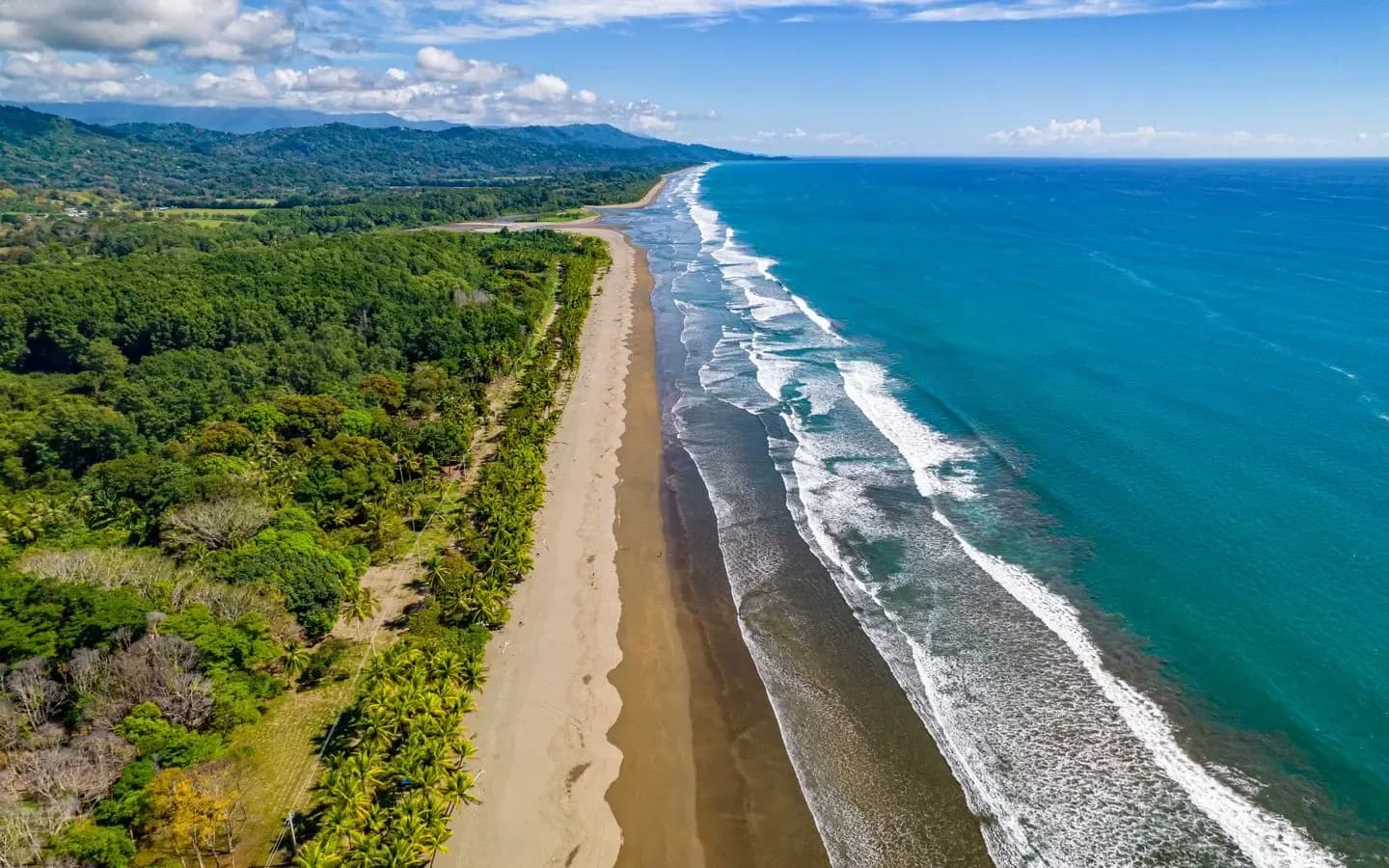
Beaches and coastline outside protected areas are your best option. Costa Rica's Pacific sunsets, river mouths and surf breaks are legal to film as long as you stay clear of crowds, wildlife, airstrips and protected land. Good practice that keeps you out of trouble:
Check the map for airstrips first, coastal towns such as Tamarindo, Sámara and Quepos have domestic runways that put much of the town inside the 8km exclusion zone
Fly early in the morning, fewer people on the beach, calmer wind, better light
Launch from private land with the owner's permission where possible
Give wildlife a wide berth, scarlet macaws, monkeys and nesting seabirds react badly to drones, and harassing wildlife is an offence in Costa Rica
Specific stretches that reward the camera legally: the quieter Nicoya Peninsula coastline between the Tamarindo, Nosara and Sámara airstrip zones, the long palm-backed beaches around Puntarenas, and Playa Hermosa south of Jacó. Before launching anywhere new, check the SINAC map for protected-area boundaries, several beautiful beaches sit inside wildlife refuges where the park ban applies.
For a sense of which regions reward the camera most, see our guide to the best places to visit in Costa Rica.
How Do You Bring a Drone Into Costa Rica?
One drone in your luggage for personal use passes through Costa Rican customs without fuss. The rules that actually matter are airline rules:
Lithium batteries go in carry-on luggage, never checked bags, a worldwide fire-safety rule
Use a fireproof LiPo pouch and tape exposed terminals
Check watt-hours, consumer drone batteries sit under 100Wh, and most airlines allow two spares
Carry proof of purchase in case customs asks whether the drone is for personal use
Is a Sub-250g Drone the Best Choice for Costa Rica?
Yes. A sub-250g drone such as a DJI Mini sidesteps Costa Rica's registration grey area entirely, draws less attention from officials, and handles the country's coastal wind surprisingly well. One caveat keeps you honest: the national park ban, airport exclusions and restricted zones apply to a 249g drone exactly as they do to a 2kg one. Weight changes your paperwork, not the airspace.
Check the DJI FlySafe map before you travel, Costa Rica's airport zones are baked into the firmware, and unlocking them requires authorisation you won't have as a tourist.
Planning to combine Costa Rica with its southern neighbour? Panama's rules are much stricter, registration is mandatory for drones over 250g and the Panama Canal is a hard no-fly zone. Read our Panama drone laws guide before you pack. And if you'd rather see both coasts of Costa Rica in one trip, our Coast to Coast holiday was built for exactly that.
This guide is general information, not legal advice. Rules were last checked in June 2026. Confirm current requirements with the DGAC (dgac.go.cr) before flying.
Planning the rest of your trip? See our complete guide to Costa Rica holidays from the UK, the best places to visit in Costa Rica, or our private Costa Rica Coast to Coast holiday.
Frequently Asked Questions
No. Recreational pilots don't need a licence or permit in Costa Rica. You must follow the DGAC's operating rules: stay under 120 metres, fly in daylight within visual line of sight, keep 8km from airports and never fly over towns, crowds or national parks. Commercial flying always requires a DGAC operator certificate.
Plan Your Costa Rica Holiday
Tell us where you want to point the camera and our specialists will design a private, tailor-made Costa Rica trip around it, flights arranged, ATOL 10898 protected.
MORE FROM TRAVELFAB
Holidays you might like
DESTINATIONS
Explore these places
KEEP READING
More stories
Costa Rica Wildlife Calendar: When to See What, Month by Month
A month-by-month Costa Rica wildlife calendar, when to see humpback whales, nesting sea turtles, quetzals and more, and where.
Is Costa Rica Safe? What UK Travellers Need to Know
Is Costa Rica safe for UK travellers? What the FCDO says, crime, safe areas, solo and family travel, health, driving and scams to avoid.